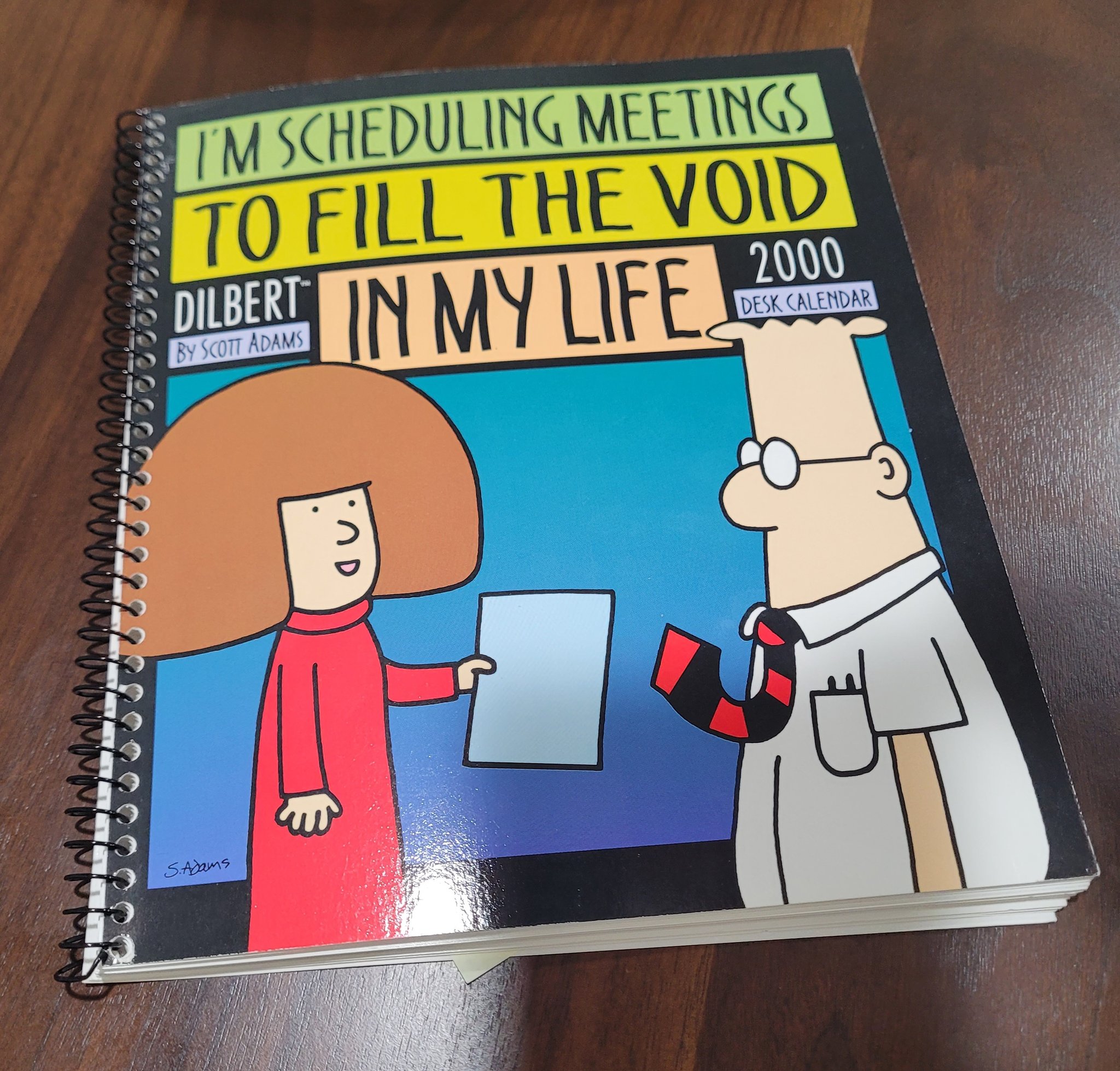
I’ve followed the work of Scott Adams for years. Decades, actually; as I just found this calendar in a box of stuff I’ve kept.
Flipping through it is actually quite illuminating, as 2000 marked the start of a six-year run at a large insurance brokerage (and human capital consultant) that you’ve heard of. And it’s inside the calendar that I’m finding a ton of evidence to one of Scott’s key messages: “Systems Over Goals.”
Creating the System
My time at Aon started in the human capital consulting arm, then known as Aon Consulting. For a young-ish guy like me, it was a tremendous opportunity: I had the chance to build a system that could best be described as “Marketing Communications.” It was also a system that had somewhat stagnated under my predecessor, and it needed a combination of a clear mandate and some good old fashioned hard work.
And, looking back at my calendar — which looked less like a journal and more like a combination of Post-It notes and birthday reminders and appointments and out-of-town trip summaries — I can see just how effective our “system” was.
Explaining Myself Further
One of the challenges of Systems Thinking vs. Goals Thinking is figuring out why you are building the system in the first place. I mean, it sounds counter-intuitive: you need to know the direction you’re headed and you have to have a general idea of what you’re trying to achieve. BUT…
To use our example, we were trying, as my then-boss was saying, to be “on the shelf of the mind” when companies — specifically, their HR leaders — were looking for an employee benefits consultant. (Back then, pre-ACA, “health and welfare” consulting was our bread-and-butter, with 401(k) consulting and pension actuarial work coming in second; HR outsourcing, a distant third, would take up a large portion of future revenues as the organization’s priorities shifted.)
To do this, we could have come up with any number of goals, but those would have had to change a couple times, at least, while we built the system.
In this case, the system needed to include a few things:
- An understanding of the issues that drive buyer behavior
- A sense of who in our company could speak to these issues; i.e. “thought leaders”
- A full mapping of the products and services that we had in the pipeline that could help clients and prospects
- And a cadence of messages — news releases, product brochures, speaking opportunities — airdropped throughout the calendar year.
We Did Pretty Well
I looked back at another Post-It that tells me that our little team actually produced 15 news releases that year; it was a variety that zig-zagged between product announcements and thought leadership pieces tied to a key piece of research that we conducted.
The news releases weren’t all, of course; and none of this was done in a vacuum. The company had a research arm in Ann Arbor, Michigan — the long-since shuttered “Loyalty Institute” — and their research was centered around what kept employees committed to their employer and what employee benefits and HR practices were (and weren’t) drivers of workforce commitment.
So we had research reports to share, and we had brochures that told our prospects how we could help them.
And we also had a bit of a chip on our shoulder; as an underdog, we were acting like a challenger brand. We were fifth- or sixth-largest in the market at the time.
Systems Are Better Than New Year’s Resolutions
There’s a point to this post: I didn’t see any New Year’s Resolutions — I normally don’t do them — and I didn’t see any goals, either.
I did see, however, the beginnings of a System.
The System for you and me today will of course be WAY DIFFERENT than the System I helped to build in 2000. So much has changed no matter the industry.
But my advice for you is to build that System for 2026:
- What PROCESSES are you good at creating, or following?
- What SKILLS can you use in order to build…A team? A business? An audience?
- What TALENTS do you need a little help with?
- What are the MARKETS where you can best find success?
You might find that you have a combination of ideas and you may be able to create a System that can set you up for success.
Go get ’em!