• Skip to main content

Area 224 Ltd.

Content + Communications Consulting

  • Blog
  • Meet Dave
  • Services
You are here: Home / Archives for B2B

B2B

Dec 29 2025

Systems Over Goals; And New Year’s Resolutions

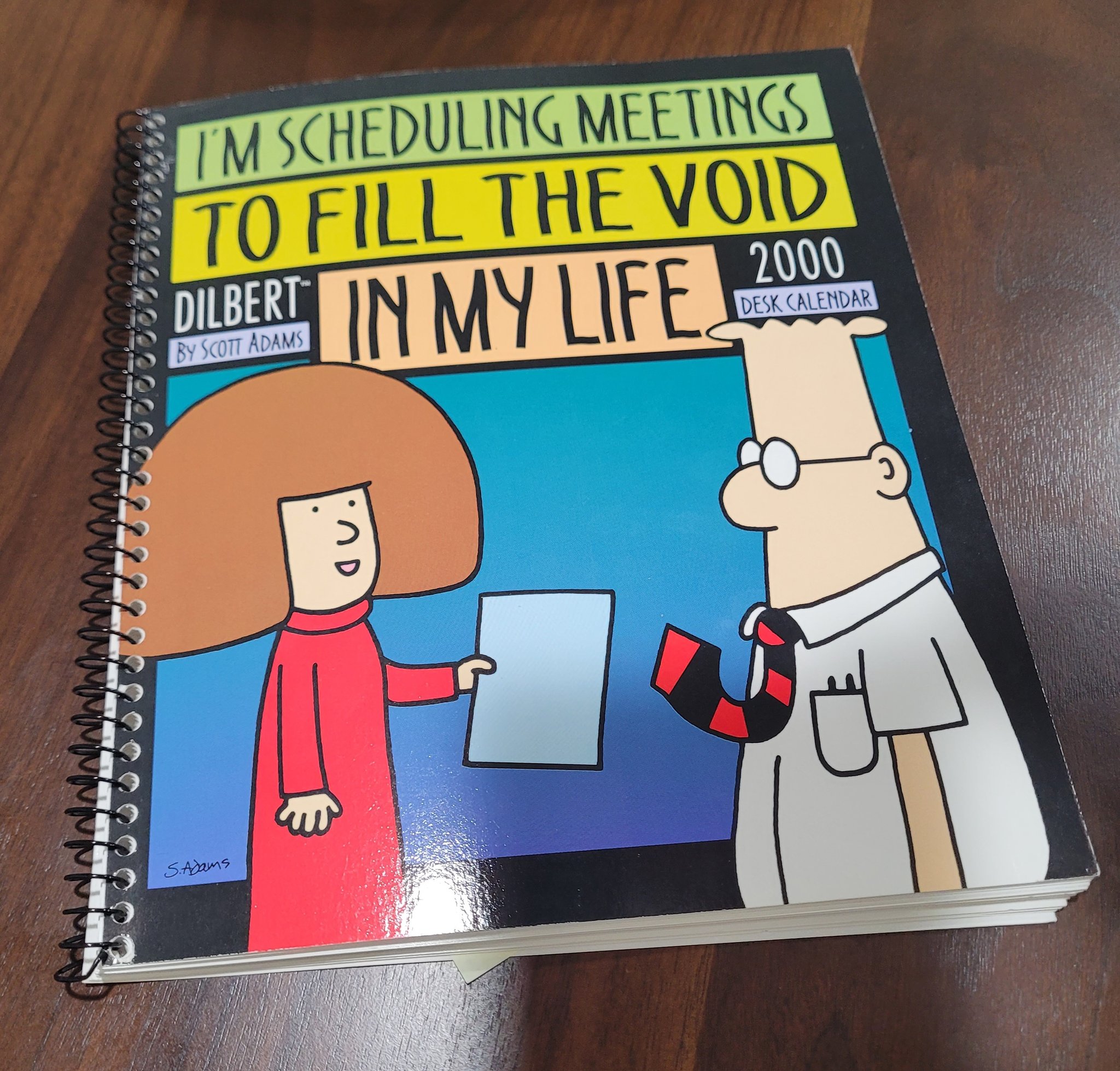
I’ve followed the work of Scott Adams for years. Decades, actually; as I just found this calendar in a box of stuff I’ve kept.

Flipping through it is actually quite illuminating, as 2000 marked the start of a six-year run at a large insurance brokerage (and human capital consultant) that you’ve heard of. And it’s inside the calendar that I’m finding a ton of evidence to one of Scott’s key messages: “Systems Over Goals.”

Creating the System

My time at Aon started in the human capital consulting arm, then known as Aon Consulting. For a young-ish guy like me, it was a tremendous opportunity: I had the chance to build a system that could best be described as “Marketing Communications.” It was also a system that had somewhat stagnated under my predecessor, and it needed a combination of a clear mandate and some good old fashioned hard work.

And, looking back at my calendar — which looked less like a journal and more like a combination of Post-It notes and birthday reminders and appointments and out-of-town trip summaries — I can see just how effective our “system” was.

Explaining Myself Further

One of the challenges of Systems Thinking vs. Goals Thinking is figuring out why you are building the system in the first place. I mean, it sounds counter-intuitive: you need to know the direction you’re headed and you have to have a general idea of what you’re trying to achieve. BUT…

To use our example, we were trying, as my then-boss was saying, to be “on the shelf of the mind” when companies — specifically, their HR leaders — were looking for an employee benefits consultant. (Back then, pre-ACA, “health and welfare” consulting was our bread-and-butter, with 401(k) consulting and pension actuarial work coming in second; HR outsourcing, a distant third, would take up a large portion of future revenues as the organization’s priorities shifted.)

To do this, we could have come up with any number of goals, but those would have had to change a couple times, at least, while we built the system.

In this case, the system needed to include a few things:

  • An understanding of the issues that drive buyer behavior
  • A sense of who in our company could speak to these issues; i.e. “thought leaders”
  • A full mapping of the products and services that we had in the pipeline that could help clients and prospects
  • And a cadence of messages — news releases, product brochures, speaking opportunities — airdropped throughout the calendar year.

We Did Pretty Well

I looked back at another Post-It that tells me that our little team actually produced 15 news releases that year; it was a variety that zig-zagged between product announcements and thought leadership pieces tied to a key piece of research that we conducted.

The news releases weren’t all, of course; and none of this was done in a vacuum. The company had a research arm in Ann Arbor, Michigan — the long-since shuttered “Loyalty Institute” — and their research was centered around what kept employees committed to their employer and what employee benefits and HR practices were (and weren’t) drivers of workforce commitment.

So we had research reports to share, and we had brochures that told our prospects how we could help them.

And we also had a bit of a chip on our shoulder; as an underdog, we were acting like a challenger brand. We were fifth- or sixth-largest in the market at the time.

Systems Are Better Than New Year’s Resolutions

There’s a point to this post: I didn’t see any New Year’s Resolutions — I normally don’t do them — and I didn’t see any goals, either.

I did see, however, the beginnings of a System.

The System for you and me today will of course be WAY DIFFERENT than the System I helped to build in 2000. So much has changed no matter the industry.

But my advice for you is to build that System for 2026:

  • What PROCESSES are you good at creating, or following?
  • What SKILLS can you use in order to build…A team? A business? An audience?
  • What TALENTS do you need a little help with?
  • What are the MARKETS where you can best find success?

You might find that you have a combination of ideas and you may be able to create a System that can set you up for success.

Go get ’em!

Written by Dave · Categorized: B2B, Thinking · Tagged: dilbert, scott adams, systems over goals

Mar 13 2012

The Marketing Guy: How to Win at B2B Marketing

Back with another in an occasional series we call The Marketing Guy. Last time, we talked about Mitt Romney’s Marketing Problem. This time? B2B Marketing, and How to Win.

Toyota Lift of Minnesota
Image from Toyota Lift of Minnesota Web Page

Remember Mr. Mom? Great movie – and in it, there’s a subplot about Schooner Tuna. The movie was set in 1983, and the economy wasn’t too great then, either. So Schooner came up with an ad campaign to show that they empathized with what everyone was going through. Here’s a quote:

“All of us here at Schooner Tuna sympathize with all of you hit so hard by these trying economic times. In order to help you, we are reducing the price of Schooner Tuna by 50 cents a can. When this crisis is over, we will go back to our regular prices. Until then, remember, we’re all in this together. Schooner Tuna. The tuna with a heart.” – Mr. Mom, 1983.

Often, B2B Marketers will hear refrains from their B2C counterparts that they need to be more “human” and they need to “empathize” with what their prospects are going through. Easier said than done – if you’ve got a CPG product that can make life easier or better (through superior benefits or taste that’s preferred 2-1 over leading name brands), life is simple by comparison. Just spend, tweak your campaigns, track everything, and there you go.

But wait, B2B Marketers have a tougher row to hoe. How can you take something like a forklift and make it more human?

Even better: how can you make your forklift more human AND report back to the CFO with numbers that show…well…positive bottom-line results?

Toyota Lift of Minnesota: The Forklift Company with a Heart

I’ve actually interacted with Kyle Thill at Toyota Lift of Minnesota for a few years now. He’s active in social media circles – especially B2B ones – and they do neat things there. A good chunk of what he’s done is behind the scenes marketing 101: lead generation, SEO, customer service, blogging. A great focus on inbound marketing keeps them top of mind with their customers and prospects.

But something that crossed my desk yesterday jumped out at me: and it’s the type of thing that B2B marketers need to do more of.

Veterans Presented with Free Lift-Truck Certification

This. Is. Brilliant.

If there’s ever the opportunity to do something positive in a crappy economy that has very little downside…this is it.

Let’s think of the possible objections to this idea:

1. It will cost too much

I don’t know what it costs to run a certification program for someone to become able to drive a forklift. But, instead, let’s say you go to the CFO with this argument:

You: What’s our training budget?

CFO: $10,000

You: What’s say we, instead, spend all that training budget to train war veterans so they can learn to drive a forklift?

CFO: And then, when someone buys a forklift from us, we can point them to some potential new hires who are certified, and who happen to be veterans?

2. We’re training a bunch of people with no forklift experience

I’ve never been in the military – but I imagine that men and women who have returned from active duty can certainly be trained to drive a forklift.

3. Doesn’t this have the appearance of a job fair? Aren’t we setting unrealistic expectations?

Yeah. Uh, no.

Home Depot to Hire 70,000 (Yes, Home Depot is hiring a bunch of people for seasonal work. Who else is hiring? Probably more companies than you’d imagine.)

So, move beyond the world where you would typically find forklifts – factories, warehouses, etc. Imagine you’re a Hiring Manager at Home Depot. A war veteran walks in, fills out an application, and, under “Certifications” can list “Forklift.” And can show a copy of the requisite certificate to match.

Going out on a limb – none of the objections can stand up to being the “Company with a Heart.”

What about those positive bottom-line results?

They might, on the surface, seem a little murkier. But roll with us for a second: take that $10,000 training budget we talked about above, and move it all over to this project. Your investment for this project for our ROI calculations is now $10,000. What are the possible returns on that investment?

New Hire Recruitment: if the company hires 5 people from this effort, instead of the normal “x” in recruitment spend, that “x” is now $2,000 per new employee.

What does it cost normally to recruit an employee? Are you better off spending recruiting dollars on something like this?

Marketing: if the company normally spends $10,000 to advertise in trade publications, or do a direct mail program, instead, if this is entirely a Marketing line item, new customers or new hires of trained associates directly from this program can be tracked accordingly.

Have you tracked spend on advertising in the past? What has it gotten you? Is this more “leverageable?”

Sales: if I’m the sales people in the organization, I fall in love with this program instantly. Heck, if it’s $10,000 out of MY budget, and I’m used to tracking all sorts of activity anyway, I add this stuff to my CRM system. What companies could be interested in a certified forklift driver? OR, who just bought a whole bunch of forklifts from me and has an opening for a certified driver? OR, which one of these men and women might fit in well as part of my team?

Even if I just spent $10,000 on lead generation, adding all of the data points from this effort can certainly give me something to go with.

The Knock on Marketing: a “Softer Science”

Quantify everything. You can’t manage what you can’t measure. Etc., etc. I won’t argue with any of this – Marketing can be a Softer Science a good chunk of the time, and we can all get better at tracking what we can, and starting to track what we haven’t tracked before.

But in this case, if you WANT to track the ROI of this exercise – you can. Or, if you want to go back to management and simply say “have a heart,” you can do that, too.

Either way – you can win at B2B Marketing.

What do you think?


Related Posts Plugin for WordPress, Blogger...

Written by Dave · Categorized: B2B · Tagged: b2b

Copyright © 2026 · Area 224 Ltd.